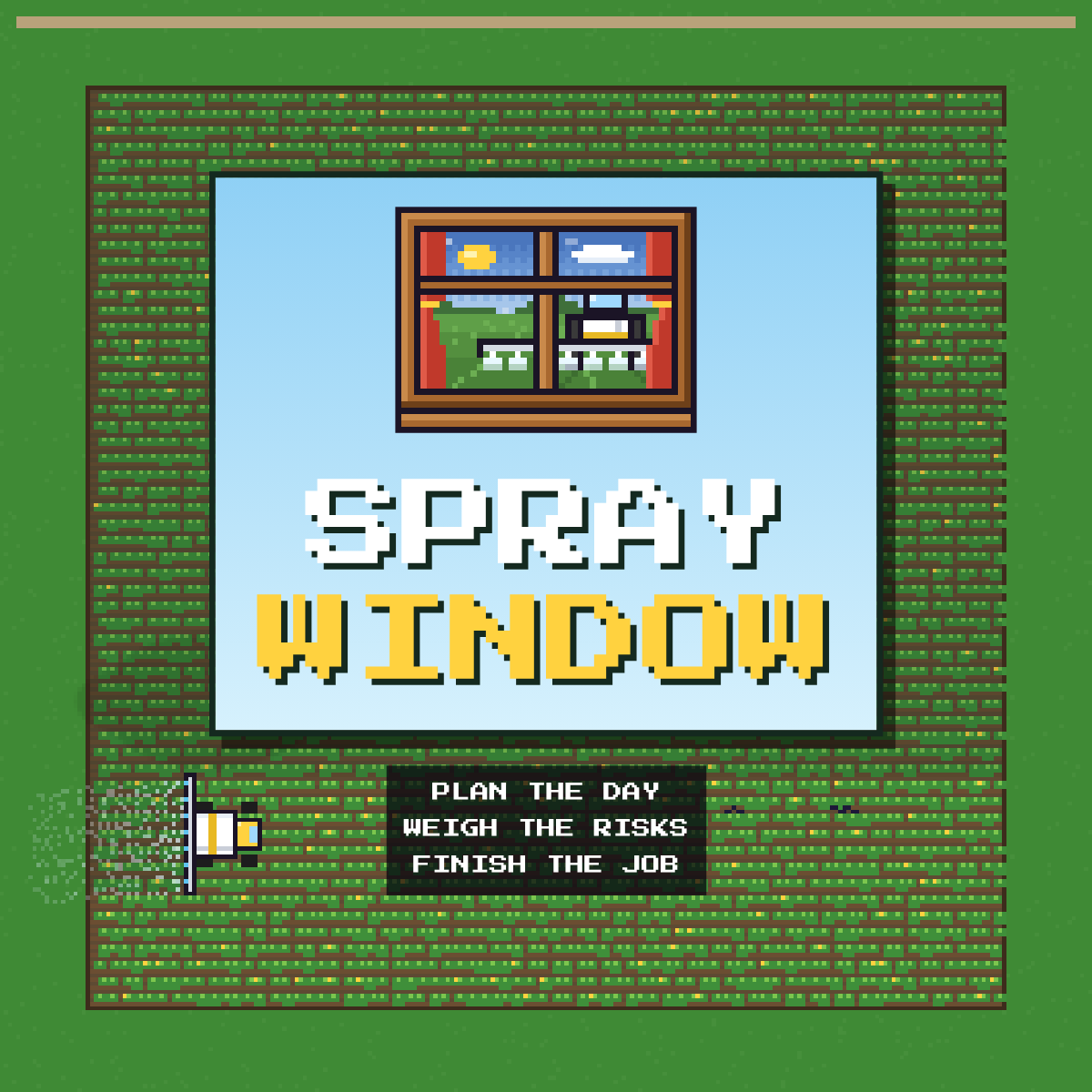
- Plan the day: read the forecast, choose the jobs, their order and the sprayer setup, and get as much done as you safely can.
- Real trade-offs: weather, crop stage, neighbours and labels all arrive at once, in a different six-day week every game.
- Instant feedback: see how you stand against a benchmark operator all week, and find out in the debrief which decisions cost you most.
This text was generated by OpenAI GPT 5 Mini
Plan the day. Weigh the risks. Finish the job.
Spray Window is a strategy game about spray planning. You have one sprayer and six working days of changeable weather. Depending on your role, you manage your own fields or a list of clients’ jobs.
Each turn is one day. Read the forecast and what each field needs, choose which jobs to do and in what order, set up the sprayer, and see how the day unfolds. There’s no single right answer.
It’s what every operator learns on the job: assess the work, plan ahead, weigh risk against reward, and get as much done as you safely can. A week takes about 20 minutes and plays best on a tablet or computer. At the end, a debrief shows what your decisions cost, what they saved, and how a benchmark operator planned the same week.
Why a game?
Sprayer training usually covers drift, Delta T, inversions, spray quality, water volume, travel speed one at a time. On a real morning they all arrive together, along with crop stage, a closing window, a neighbour, and someone waiting on the work.
Those decisions rarely have one correct answer, so they’re hard to teach in an article or test with a quiz. An owner facing a closing disease window might reasonably accept more drift risk than a custom applicator whose business depends on reputation. Both may be making a sound call.
A simulation lets you decide, live with the consequences and try again. In Spray Window, the opponent is the weather and the clock, not another player. And, of course, it’s a fun 16-bit style that reminds me of a lot of wasted quarters in my youth.
How it plays
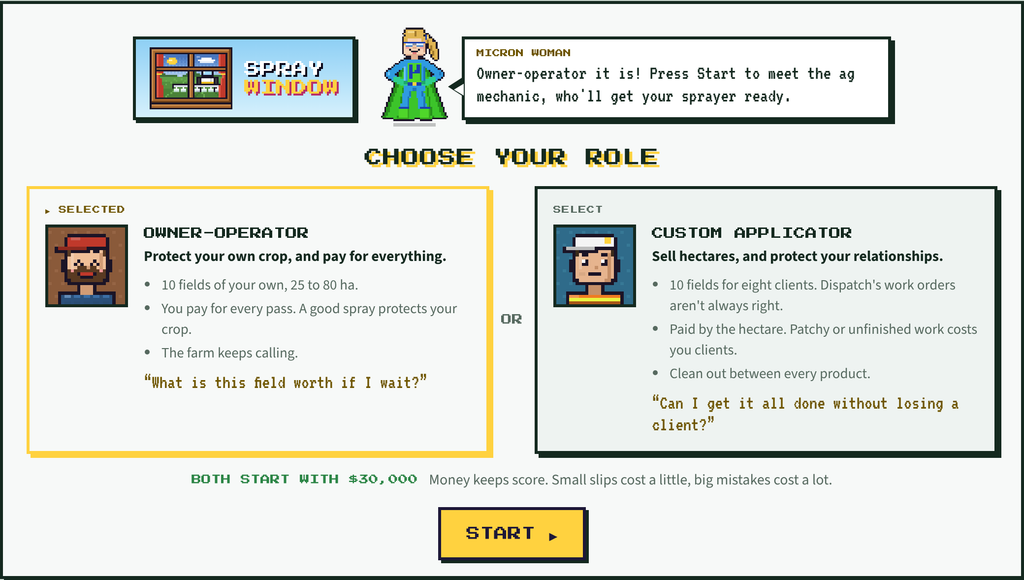
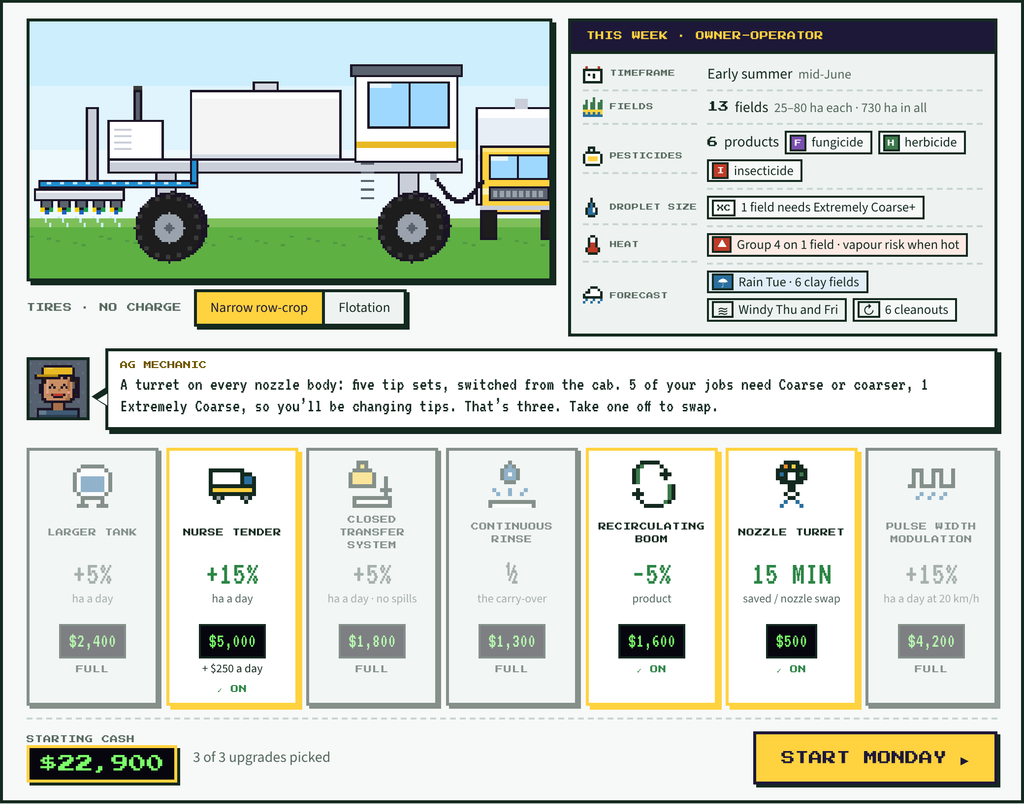
The game is set in Ontario mostly on corn, soybeans and winter wheat, with canola, white beans, sugar beets, processing tomatoes and potatoes in some weeks. Every week is a new combination of fields, crops, pests and weather, in one of three seasons. Choose your role (owner-operator or custom applicator), outfit your sprayer on a limited budget, pick your tires, and dive in. The weather changes, and there are surprises to deal with.
Micron Woman is back to be your guide.
Spring
In mid-May, jobs include herbicide and fungicide in wheat, a pre-emergence herbicide before the corn comes up, a burndown ahead of soybean planting, and insecticide for cereal leaf beetle and black cutworm at threshold.
Early Summer
In mid-June, jobs include fusarium head blight at wheat flowering, a Group 4 herbicide before the corn’s crop-stage limit, post-emergence herbicides in soybeans, and armyworm in wheat.
Mid-Summer
In late July, jobs include tar spot at corn tassel, white mould and soybean aphid in soybeans, western bean cutworm, and a pre-harvest herbicide as wheat dries down.
Drift
Every field borders something sensitive: open water, a neighbour’s home and garden, beehives in a flowering hedgerow, a vineyard or a certified organic farm. Each responds as it would in real life.
When water or habitat is downwind, the label may require an unsprayed buffer, and coarser sprays shrink it. Heat brings another risk: after application, a Group 4 herbicide such as dicamba can turn to vapour and move off target whatever the nozzle. In June, a cooler day or a pass after the heat of the day may be the safer call.
Sometimes, not spraying is the right move.
High scores, weekly scenarios and feedback
Money keeps score. Beside your money, a second readout shows whether you’re ahead (▲) or behind (▼) the benchmark operator playing the same week. Every off-label pass is a label strike and a fine, so bad calls sting right away. If your balance falls below zero, you’re broke and the week ends with zero points.
A score of 1,000 means you finished as well off as the benchmark. Both roles use the same yardstick, and weeks are drawn from scenarios of similar difficulty, so scores are comparable.
Ranks are awarded as follows:
- Apprentice (0-499)
- Operator (500+)
- Pro (800+)
- Ace (950+)
- Legend (1,100+)

At the end of the week you get your report card. “Turning points” shows the three decisions that cost you most and what the forecast would have allowed instead.
Enter your initials arcade-style. On sprayers101.com your score is sent to the leaderboard automatically. The leaderboard replays your week to confirm it and it goes up once we approve it. Playing a downloaded copy? Email the code from the end screen to jason@sprayers101.com. Only a week’s first play counts; “Play this week again” is for practice.
Thanks to Dr. Ian McDonald for the inspiration to build a game. Ready to play?
High Scores
| Place | Initials | Points | Rank | Role |
|---|---|---|---|---|
| 1 | JAY | 1,072 | Ace | Owner-operator |
| 2 | JAY | 866 | Pro | Custom applicator |
| 3 | — | — | — | — |
Versions: Updated October 28, 2026: Interface made more clear and concise. Removed logbook (redundant). New spray scenarios added. Results page easier to read and learn from. Scores from earlier versions still count. More changes anticipated on Nov 1 based on player feedback.
